Multi-Region Data Residency Architecture for AI Chatbot Applications on AWS
Say you're a company headquartered in Singapore with legal entities in the USA, Canada, Germany, Switzerland, and China. You run one product: an AI chatbot platform that orchestrates department bots. HR, finance, IT helpdesk, all behind a single chat interface.
One codebase, five jurisdictions. And one constraint that shapes everything else: a US user's conversations, documents, and embeddings must never be stored in or served from China. A German user's data stays in the EU. A Chinese user's data stays in China. This isn't a latency preference. It's law, and the penalties for getting it wrong are brutal.
Here's how I'd build this on AWS, with attention to the parts that are specific to AI applications, because chatbots leak data in places a normal CRUD app doesn't.
The legal map is smaller than it looks
Before drawing any boxes, be realistic about the actual rules. They're not all equally strict, and some of these countries legally trust each other:
- Germany falls under GDPR. Personal data leaves the EU only through approved transfer mechanisms, and enterprise customers often demand EU-only storage in contracts anyway.
- Switzerland isn't in the EU, but the two have mutual adequacy decisions. Data flows freely between Germany and Switzerland, so they behave as one geography.
- The USA and Canada have no general data localization law. PIPEDA and the US sector rules govern how you handle data, not where it sits. Also one geography.
- China is the strict case. Under PIPL and the Data Security Law, personal data collected in China stays in China, and getting it out requires a government security assessment.
So the real map isn't five isolated countries. It's three legal geographies: North America, Europe, and China. Build five hard-walled country cells when the law demands three and you're paying for two extra sets of infrastructure forever, for nothing.
One rule doesn't change, though. Within whatever boundaries you draw, compliance by policy always fails eventually — someone ships a bug, a background job replicates the wrong table. What you want is compliance by architecture: a system where cross-boundary access is impossible, not merely forbidden.
Why AI chatbots make this harder
A normal web app has one data store to worry about. A chatbot platform scatters personal data across places that are easy to forget:
- Conversation history. People paste salary details, medical questions, and internal documents into chat.
- Embeddings. A vector derived from a German user's HR complaint is still personal data. Store it in a US OpenSearch cluster and you've violated residency, even though "the text" never left.
- Model inference. When your app in Frankfurt calls a model endpoint in
us-east-1, the full prompt crosses the border in the request body. Where you run inference is a data transfer decision. - Prompt logs and traces. Observability pipelines love logging full prompts. Those logs are personal data too.
- Agent-to-agent traffic. The supervisor passes user context to department bots on every turn. Each hop is an escape route.
Residency here means storage, inference, embeddings, logs, and orchestration traffic all stay in-region. Not just the database.
The core pattern: regional cells, thin global control plane
Each legal geography gets a self-contained cell that can run the whole product on its own. Above the cells sits a deliberately tiny global control plane that knows exactly one thing: which tenant lives in which cell.
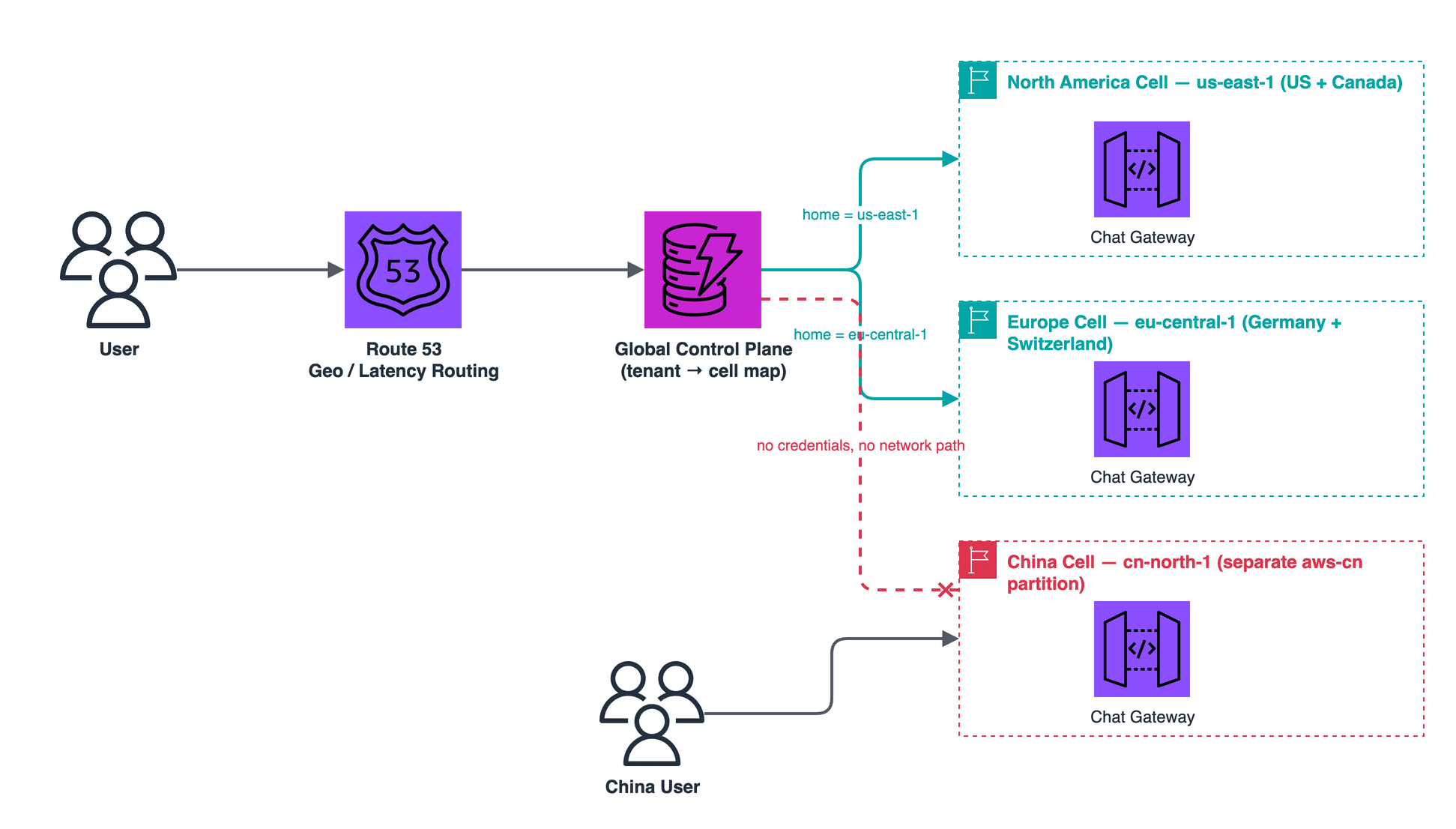
China is drawn disconnected from the control plane. That's intentional, and we'll get to it.
Tenants can be pinned tighter than the law requires
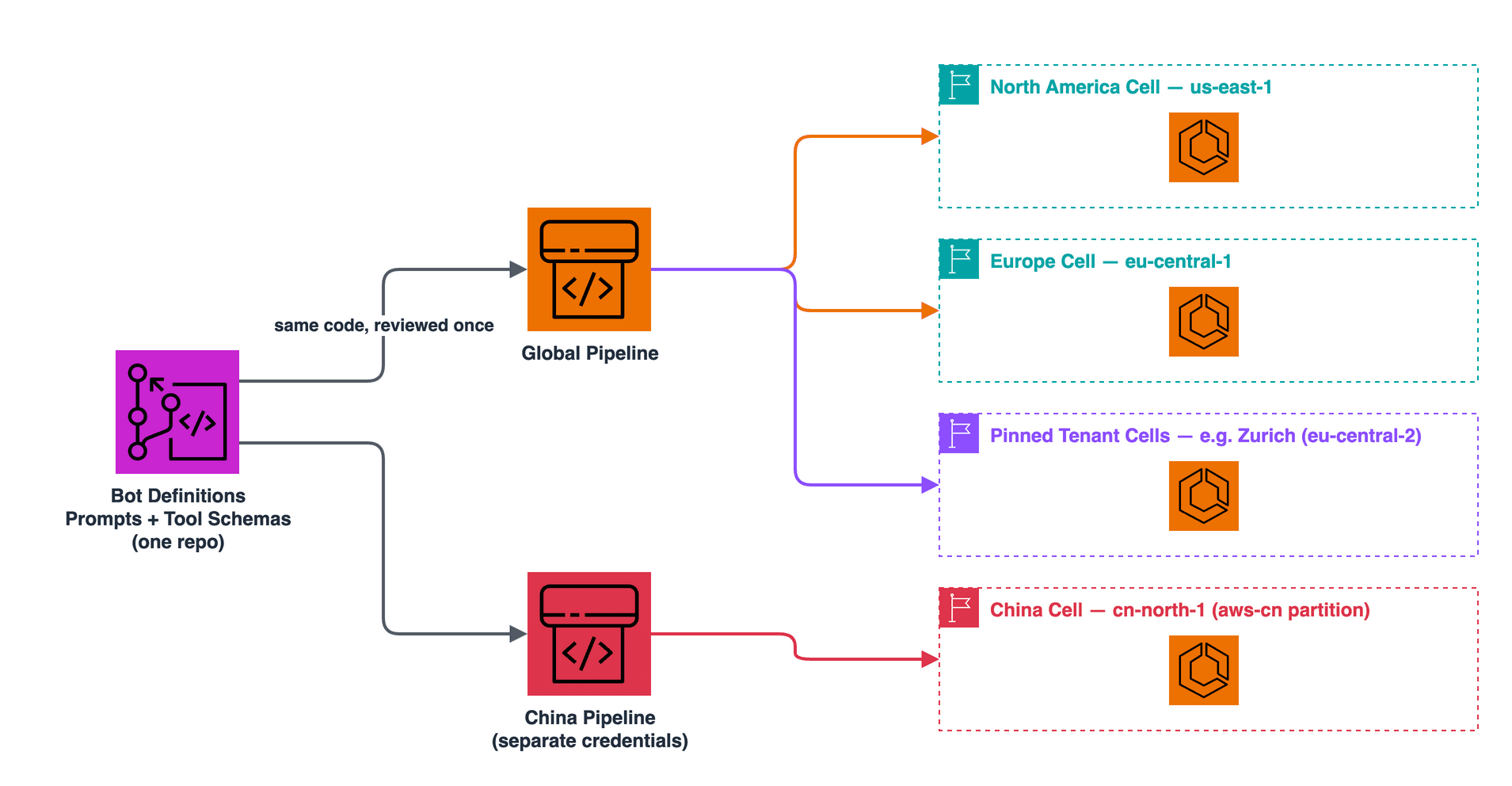
Keep the mapping per tenant, not per country, because contracts are stricter than laws. A Swiss private bank may only sign if their data physically sits in Switzerland. Since routing is driven by the tenant record, you can spin up a dedicated Zurich (eu-central-2) cell for that one customer and pin them to it without touching the architecture. Country pinning is a premium exception you charge for, not something you pre-build.
The control plane: boring and small
It stores tenant metadata only — organization ID, home region, tier, feature flags. Never user content. A DynamoDB global table works well, because this small mapping is the one thing you actually want replicated everywhere:
{
  "tenant_id": "acme-germany-gmbh",
  "home_region": "eu-central-1",
  "entity_country": "DE",
  "allowed_regions": ["eu-central-1"],
  "tier": "enterprise"
}
My rule of thumb: if the control plane leaked publicly tomorrow, it should be embarrassing but not a GDPR incident. Any field that fails that test belongs in a cell.
The data plane: everything else lives in the cell
Each cell runs the full stack:
- Chat gateway, supervisor agent, and department bots on ECS/EKS or Lambda in that region.
- Conversation store in DynamoDB or Aurora. Single region, no global tables, no replicas.
- Vector store per cell (OpenSearch Serverless or Aurora pgvector), indexing only its own tenants' documents.
- Bedrock invoked in the same region, cross-region inference profiles disabled for regulated tenants.
- Per-cell S3 buckets for uploads, with policies denying access from outside the cell's account.
- CloudWatch scoped to the region, prompt content redacted at the collector.
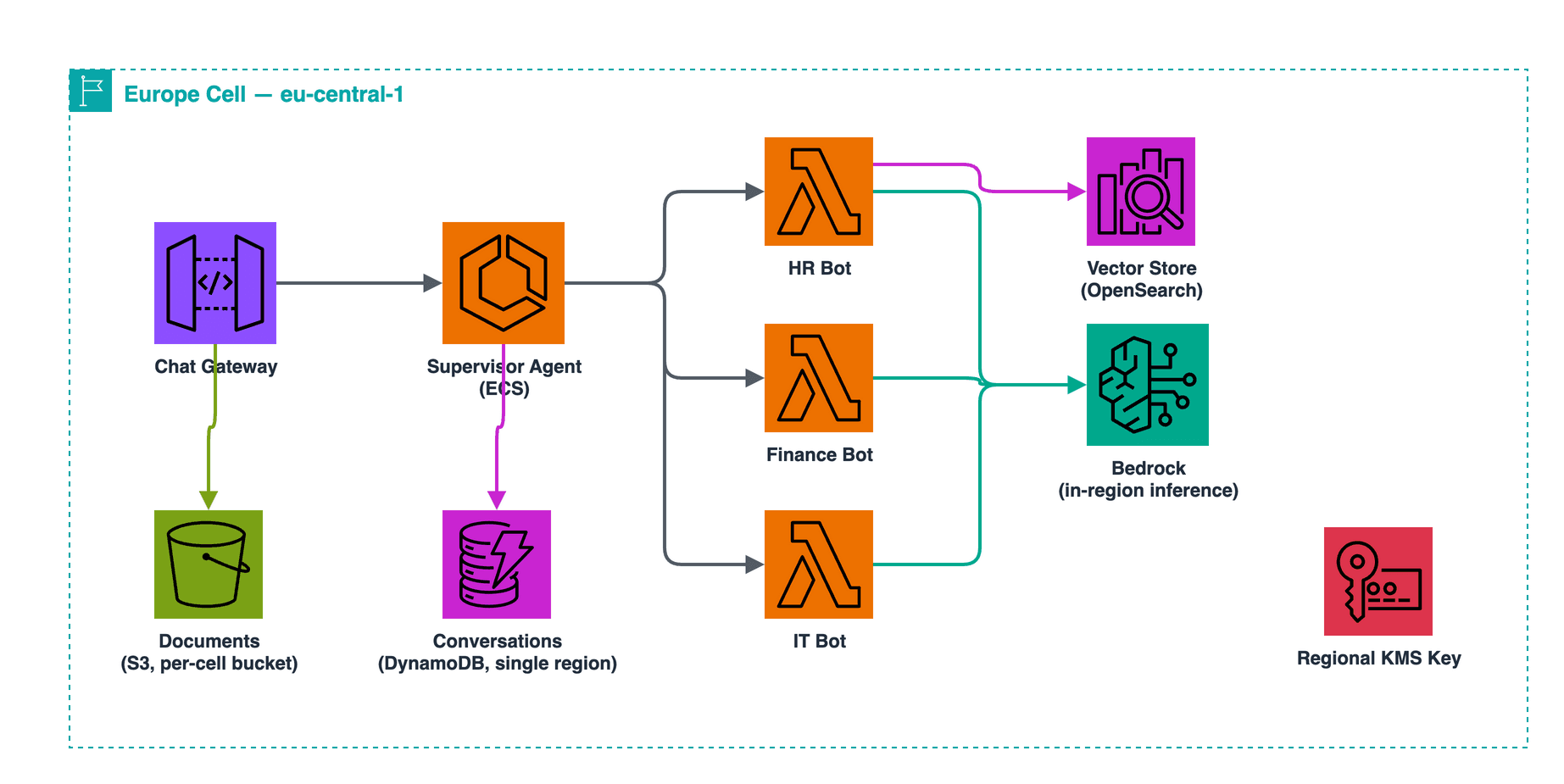
Every arrow stays inside one region. There's no code path across the boundary because there are no credentials and no network routes that would let one exist.
Request routing: how a user finds their home cell
Routing has two layers. Don't confuse them.
Layer one is network proximity: Route 53 sends the user to the nearest edge. Pure performance, says nothing about data.
Layer two is tenant residency: the landing cell looks up the tenant in the control plane. If the tenant's home is elsewhere, the request gets an HTTP 307 redirect to the regional endpoint, before any user content is accepted.
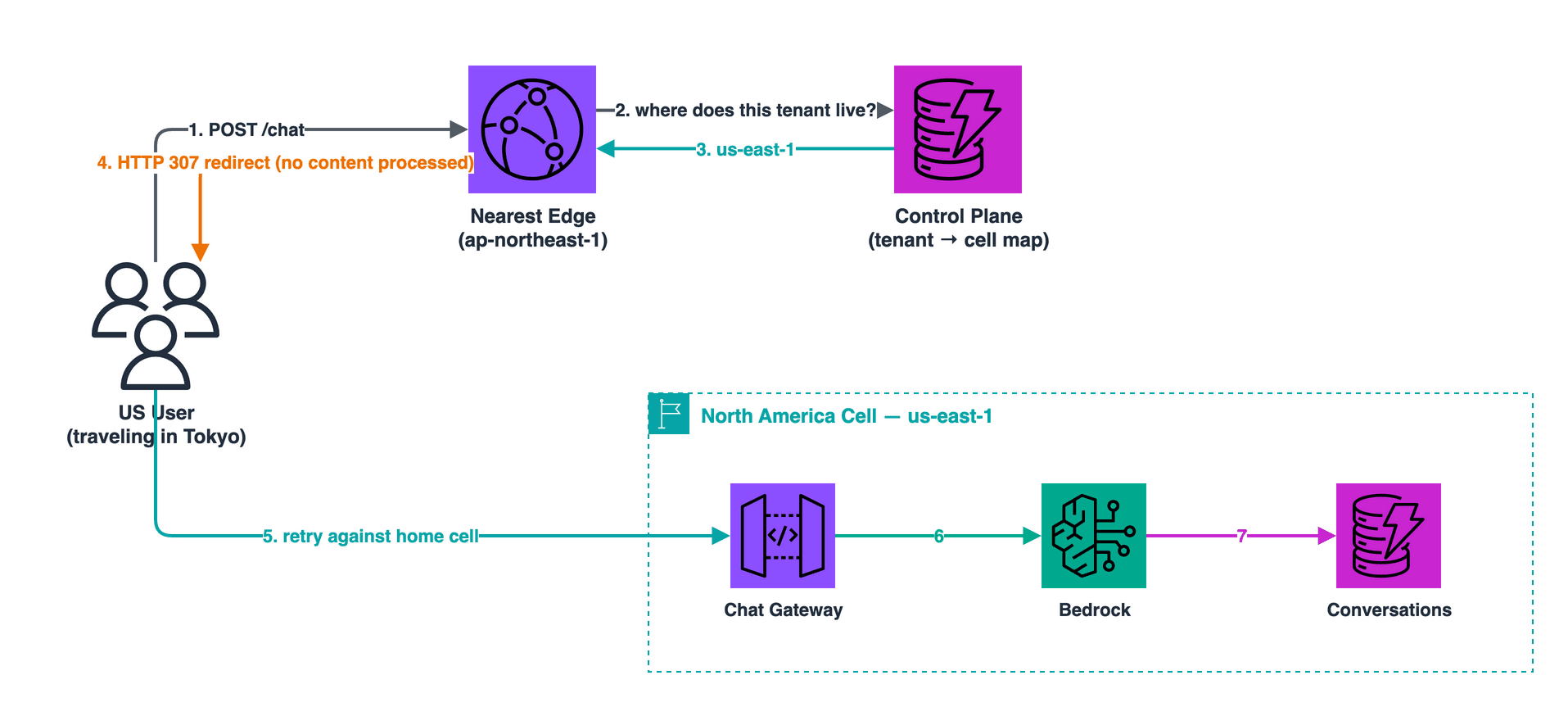
This settles the traveling-user question. A US user opening the app in Tokyo or Shanghai still reads and writes only against the North America cell. Latency suffers, compliance doesn't. The one thing to get right: reject then redirect, never process then forward.
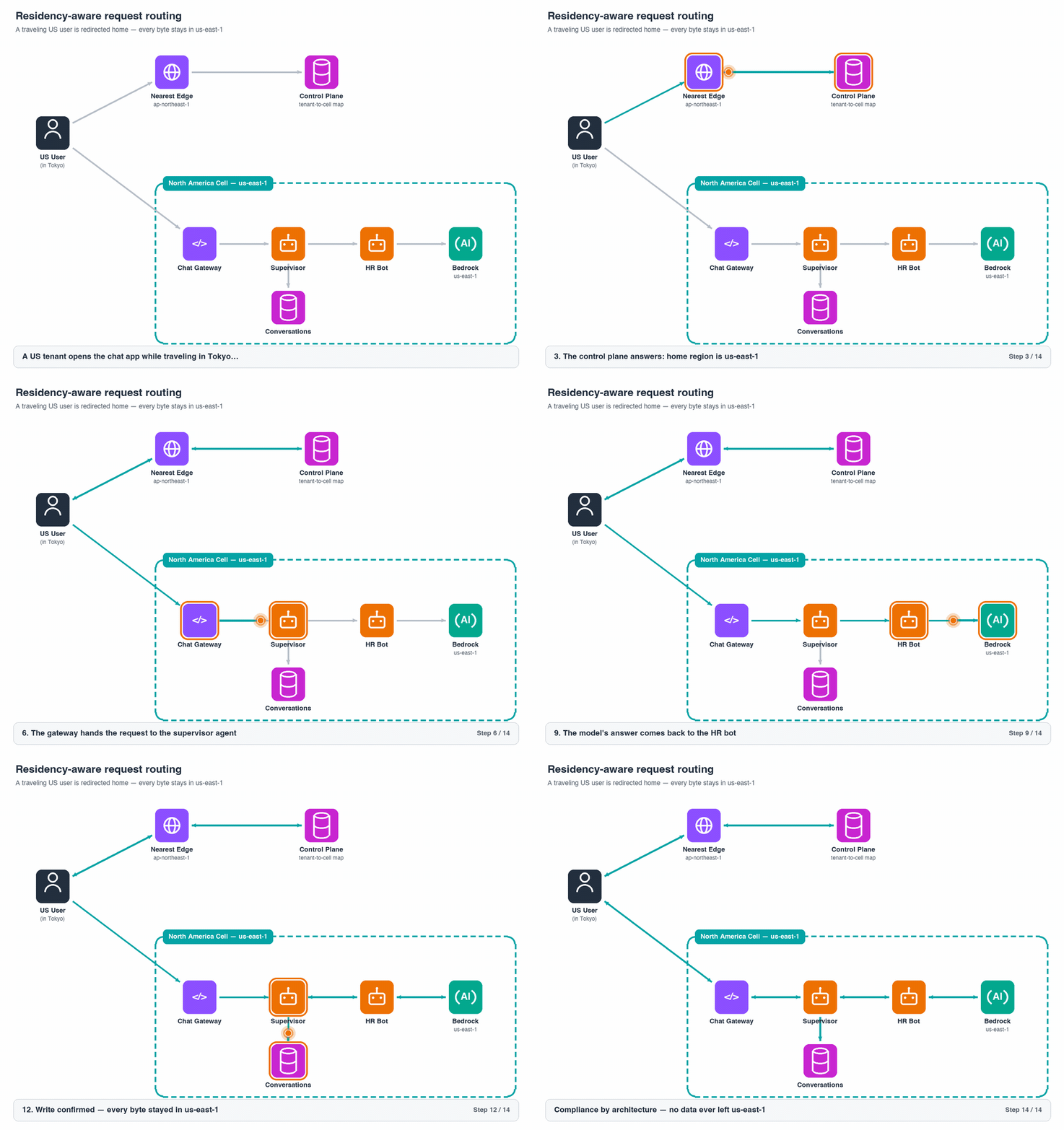
Here's the whole flow animated, end to end: the traveling user gets redirected home and served entirely inside the North America cell, step by step.
The China cell: a separate partition, and that's a feature
AWS China (cn-north-1, cn-northwest-1) isn't just another region. It's a separate AWS partition (aws-cn), operated by local partners (Sinnet and NWCD), with its own accounts, IAM, and credentials. A role in your global organization physically cannot assume a role in the China partition.
Most teams treat this as an annoyance. For data residency it's exactly what you want: the strongest isolation boundary in the architecture is one AWS enforces for you. In practice:
- The China cell runs from a separate deployment pipeline with its own artifact store. Same application version, zero shared runtime credentials.
- The control plane doesn't replicate into China. The China cell carries its own tenant table.
- Bedrock isn't available there, so the China cell runs a local model behind the same internal inference interface. Abstract model calls from day one: the orchestrator asks for "the reasoning model" and cell config decides what that resolves to.
- Chinese-entity users get
cndomains and an identity provider deployed in China.
"A US user will never get or save data in the China region" stops being a policy you enforce and becomes a property of the partition boundary. No credential exists that can bridge it.
Guardrails: making violations impossible
Within the global partition, the cells share an AWS Organization, so you need explicit guardrails. Three layers:
1. SCPs pin each account to its region. Each cell gets its own AWS account, and a Service Control Policy denies everything outside the cell's home region:
{
  "Effect": "Deny",
  "NotAction": ["iam:*", "route53:*", "cloudfront:*", "support:*"],
  "Resource": "*",
  "Condition": {
    "StringNotEquals": { "aws:RequestedRegion": "eu-central-1" }
  }
}
Code in the Europe cell can't even create a bucket in us-east-1. A misconfigured replication job fails at the API level.
2. Regional KMS keys make foreign data unreadable. Every store is encrypted with a key that lives in the cell's account and region, with access granted only to the cell's roles. Even if bytes crossed the boundary, they'd be ciphertext with no reachable key.
3. Bedrock inference stays in-region. Bedrock's cross-region inference profiles route requests to other regions for capacity. For regulated tenants, use single-region invocation, or geography-scoped profiles that match the legal boundary — an EU profile is fine for a German tenant, a global profile is not. Deny bedrock:InvokeModel on foreign-region model ARNs so the decision is enforced, not remembered.
On top of these, run continuous verification: AWS Config rules flagging anything created with cross-region replication, CloudTrail alarms on any foreign aws:RequestedRegion. The guardrails prevent violations; the audit trail is how you prove it, and under GDPR and PIPL you will be asked to prove it.
Multi-bot orchestration under residency constraints
Orchestration topology is itself a residency decision. The rule: the supervisor and all department bots for a tenant deploy together in the tenant's cell. Resist the temptation to centralize expensive bots ("the finance bot runs in Singapore and serves everyone"). That shared bot would receive user context from every jurisdiction, and it would be your compliance breach.
What can be shared globally is everything that's code rather than data:
- Bot definitions, prompt templates, and tool schemas. Version them in one repo, review once, deploy identical copies everywhere.
- Model configuration, resolved per cell: Bedrock Claude in North America and Europe, a local model in China.
- Evaluation suites, run per cell against synthetic data. Never by exporting real conversations to a central test environment.
Company-wide data: the tier that should be everywhere
Don't get so focused on isolation that you forget the opposite requirement. A large share of the platform's data is company-wide and should be identical worldwide. Residency laws restrict personal data; they say nothing about your own corporate content.
The global tier typically includes:
- The company knowledge base: HR policies, IT runbooks, product docs. This is what RAG retrieves from, and a Frankfurt employee and a Toronto employee should get the same answer.
- Bot definitions and prompt templates — corporate IP, not personal data.
- Reference data: product catalogs, office locations, holiday calendars, feature flags.
- Pre-computed embeddings of all of the above, built once in the pipeline and shipped to every cell as a versioned artifact. Otherwise cells embed the same documents independently and drift apart.
The pattern is publish-subscribe in one direction only. A global content pipeline pushes these artifacts into every cell, including China — importing your own non-personal content into China is unproblematic; it's personal data leaving that triggers assessments. Nothing ever flows back out of a cell into the global tier.
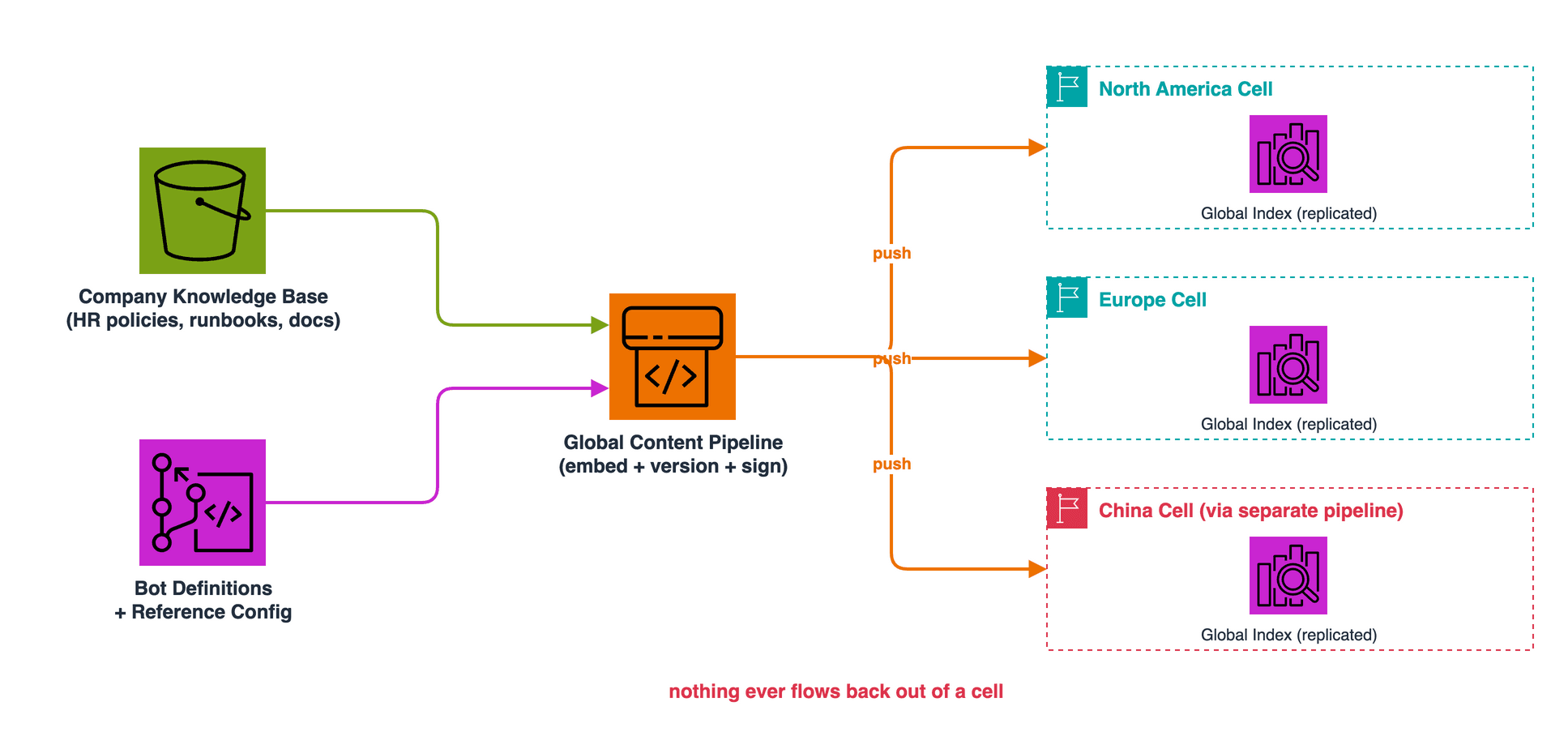
Each cell ends up with two vector indexes with different legal status: the replicated global index (company knowledge, overwritten on every release) and the local index (user uploads and conversation-derived embeddings, never leaves the cell). The retrieval layer queries both and merges results, but their lifecycles never mix.
One discipline keeps this tier safe: the global pipeline accepts reviewed corporate content only, never anything a user typed or uploaded. The moment someone adds "helpful conversations" to the shared knowledge base, personal data starts replicating worldwide. If you want to learn from conversations, do it in-cell.
The remaining hard problems
Three things don't fit neatly into cells, and each deserves a deliberate decision rather than an accident.
1. Cross-region analytics
- Leadership in Singapore wants one dashboard: conversations per day, resolution rates, model costs across all entities.
- The pattern: aggregate in-cell, export only anonymous numbers to a central analytics account.
- Never message content, never user identifiers. If an analyst could reconstruct an individual from what crosses the border, too much crossed the border.
- China usually needs its own dashboard, or a manual export process that has been through assessment.
2. Tenant migration
- The trigger: an employee transfers from the US entity to the German entity, or a subsidiary gets reorganized.
- The runbook: export from the source cell, transfer under an approved legal mechanism, import into the destination, verify deletion at the source, flip the control-plane pointer last.
- Keep it a rare, audited, human-approved workflow. Not an API anyone can call.
3. Consistent product behavior
- Cells drift if you let them.
- Run the same application version everywhere. China may lag a release, and that's fine.
- Define infrastructure once in Terraform or CDK, instantiate per cell with region parameters, and smoke-test every cell in the pipeline.
- Cell architecture only stays cheap when cells are stamped from one template instead of hand-grown.
Closing thoughts
Split the system into self-contained cells per legal geography, each holding storage, inference, embeddings, logs, and the full bot orchestration for its tenants. Keep a thin global control plane that maps tenants to cells and holds nothing personal. Route requests home before any content is processed. Enforce the boundaries with account-per-cell SCPs, regional KMS keys, and in-region model invocation. Treat China as the separate partition it already is. And run a one-way pipeline that pushes company-wide knowledge into every cell, so isolation never degrades the product.
If you take one thing from this post: data residency is not a database setting. A chatbot's personal data lives in conversation stores, vector indexes, prompt logs, and inference request bodies. Design the cells around the database alone and the embeddings and model calls will quietly betray you. Make the wrong thing structurally impossible — no credential, no network path, no code path — and compliance stops depending on everyone being careful forever.